
The AI Developer Paradox: How AI Expanded (Not Eliminated) the Developer Community

Remember where you were on November 30, 2022? Most people don’t. It was just another Wednesday. But that unremarkable day changed everything when OpenAI quietly released ChatGPT to the public.
What happened next was unprecedented: 1 million people signed up in five days. By January 2023, it had shattered every record for consumer software adoption in history.
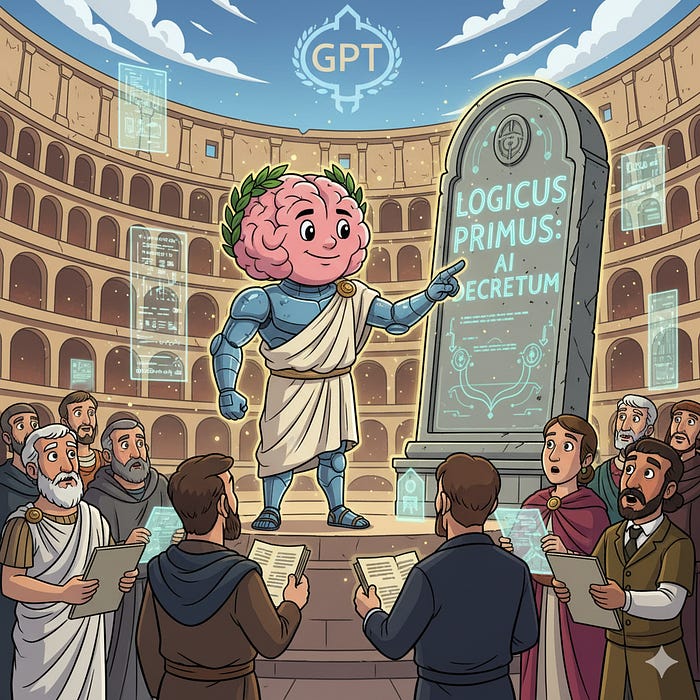
That moment sparked the biggest career crisis in tech since the dot-com crash. Suddenly, every developer was asking the same question: Am I about to be replaced by a chatbot? The fear made sense. If AI could write code, debug programs, and even explain complex algorithms, what did that mean for the millions of people who do that for a living?
But while many were busy writing their professional obituaries, something interesting was happening in the actual data. The numbers were telling a completely different story.
ChatGPT’s release sent shockwaves through the developer community. Three years later, the data reveals an astonishing truth: instead of eliminating developers, AI triggered the largest expansion of the developer community in computing history. As AI tools became more sophisticated, the number of people building software didn’t shrink, it exploded.
AI didn’t replace developers. It democratized development, creating millions of new builders while making existing developers more productive than ever.
The Numbers: Unprecedented Developer Growth
The statistics paint a picture that contradicts everything we were told to expect:
Enterprise Application Development Shift: By 2025–2026, about 70–75% of new enterprise applications will be built with low-code or no-code platforms, up from less than 25% in 2020.
% of Developers / Organizations Using LCNC Tools: The share of developers using LCNC tools rose from 46% to 57% in just 18 months. That’s millions of traditional developers embracing the tools that were supposed to replace them.
Market Value Explosion: The global market for Artificial Intelligence Code Tools was valued at $6.7 billion in 2024 and is projected to reach $25.7 billion by 2030, growing at a CAGR of 25.2%
The Five Mechanisms Behind the Paradox
1. Barrier Elimination
Before AI: Building software meant years of learning programming languages, mastering debugging techniques, and understanding complex system architecture. It was like learning to be a mechanic before you could drive a car.
The new reality: Now your marketing manager can describe what she needs in plain English and get working automation. Your sales director can prototype lead-scoring systems during lunch.
2. Amplified Developer Productivity
Think of AI as every developer’s personal coding assistant; one that never gets tired, never makes typos, and never argues about code style.
Google put this to the test: 96 software engineers, real projects, measurable results. The engineers using AI features completed their tasks 21% faster than those working the old way.
But speed isn’t the only benefit. When developers aren’t spending hours on repetitive code and debugging syntax errors, they tackle more ambitious projects. The same team that used to build one feature now builds three. The same developer who used to focus on maintenance now experiments with innovative solutions.
3. New Developer Categories Created
The Classic Lineup
Frontend / Backend Developers
Full-Stack Developers
DevOps Engineers
The New Players on the Field (AI Era):
Citizen Developers: Business experts who build their own solutions using AI-powered platforms
Prompt Engineers: The AI whisperers who know exactly how to get the best results from AI tools
AI-Assisted Developers: Traditional coders supercharged with AI capabilities
No-Code/AI Hybrid Builders: Visual developers who combine drag-and-drop interfaces with intelligent automation
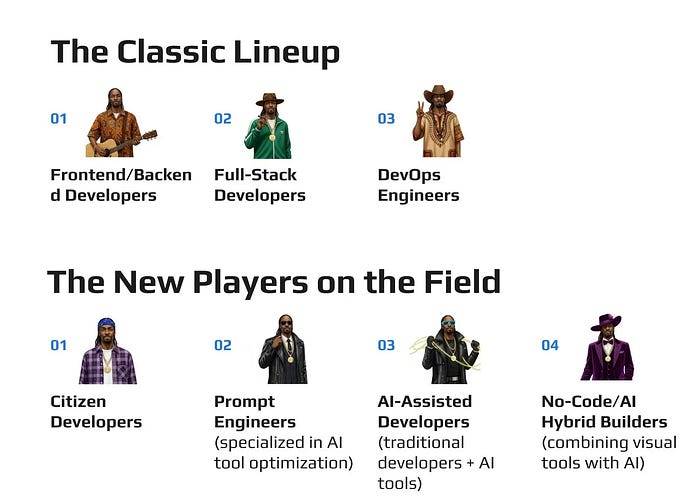
Each category represents millions of people who wouldn’t have been considered “developers” five years ago but are now building functional, valuable software every day.
4. Demand Outpacing Automation: The Efficiency Paradox
Here’s the counterintuitive part: when you make something easier and cheaper, people want more of it, not less.
The evidence is everywhere:
60% of Fortune 500 companies adopted Microsoft Dynamics 365, each requiring extensive customization
Salesforce serves 327,297 customers, all demanding unique workflows and integrations
Every productivity gain from AI tools gets reinvested into bigger, more complex projects
It’s like when calculators didn’t eliminate mathematicians, they enabled more complex mathematics. AI tools didn’t reduce the need for software, they made it possible to build software for problems we never thought were worth solving before.
5. Tool Evolution Pattern
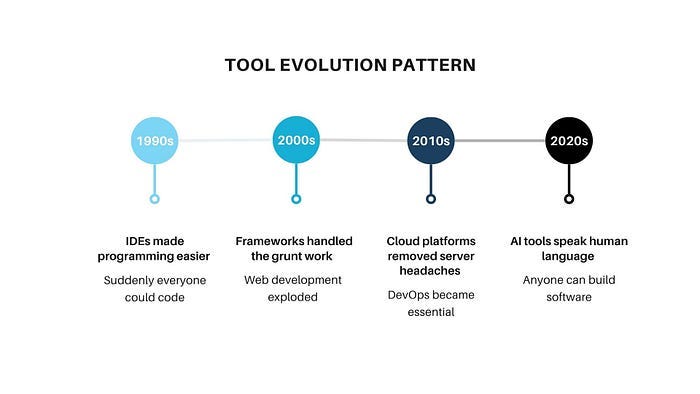
This story has played out before, and it always ends the same way: better tools create more opportunities:
1990s: IDEs made programming accessible → Programming jobs exploded
2000s: Web frameworks simplified development → Web developer boom
2010s: Cloud platforms removed infrastructure complexity → DevOps revolution
2020s: AI tools speak human language → Citizen developer explosion
The pattern is unmistakable: every productivity breakthrough expands the professional community rather than shrinking it.
The historical pattern of technology expanding professional communities
The Redefinition of the Developer role
Okay, let’s be honest. Some developers are getting laid off. But here’s what’s actually happening: AI isn’t eliminating the developer role, it’s evolving it.
Think of it like when smartphones killed flip phones. Nokia didn’t disappear because phones became obsolete, they got left behind because they didn’t adapt to what phones needed to become.
Pre-AI, developers generally needed formal training, mastery of languages and frameworks, knowledge of system architecture and databases, and strong debugging skills.
In the AI era, the developer role expanded to include new levels:
Level 1: AI-assisted traditional developers use AI for code generation, debugging, and optimization, while focusing on architecture and complex problem-solving → Their productivity increased 25–40% on average
Level 2: Hybrid Citizen Developers are domain experts who use AI and no-code tools to build applications without traditional coding. Examples include marketing automation specialists and sales operations analysts.
Level 3: AI Prompt Specialists focus on guiding AI tools to deliver specific outcomes. They bridge business needs with AI capabilities, creating a new role category with emerging career paths.
Level 4: No-Code/AI Integrators combine visual development with AI to automate workflows and optimize business processes. This role is growing rapidly across enterprise environments.
Job Market Reality Check
Despite all the “AI will steal your job” headlines, developer job openings are still at record highs, salaries keep going up, and new AI-focused roles like Prompt Engineer and AI Integration Specialist are actually paying more than traditional coding jobs.
The developers struggling aren’t being replaced by AI: they’re being outcompeted by developers who learned to work with AI.
Productivity vs. Replacement
AI took over the grunt work: repetitive code, debugging typos, basic database operations, documentation, and simple testing. All the stuff that made you wonder why you got into programming in the first place.
This freed developers to tackle the good stuff: complex problem-solving, experimental features, cross-platform integrations, AI optimization, and automating entire business processes. The work that actually requires creativity and strategic thinking.
The result? AI didn’t eliminate developer work. It just shifted it from mind-numbing tasks to the challenging projects developers actually want to do.
Conclusion: The Paradox Resolved
The AI developer paradox resolves into a predictable outcome: revolutionary tools don’t replace professionals. They grow them by lowering barriers and supercharging existing talent.
In conclusion:
AI didn’t replace developers → it redefined development
Barriers fell, demand exploded → community expanded
More productive developers meant bigger, bolder projects became possible
“Developer” meant a lot more than just someone who writes code
We’re witnessing the largest expansion of the developer community in computing history, powered by the very AI technologies that were supposed to make developers obsolete.
This isn’t just a statistical anomaly: it’s a fundamental shift in how software gets built, who builds it, and what “development” means in 2025 and in the AI era.
Sources & Further Reading
Developer Growth & AI Impact:
Market Growth & Low-Code Trends:
Industry Analysis: